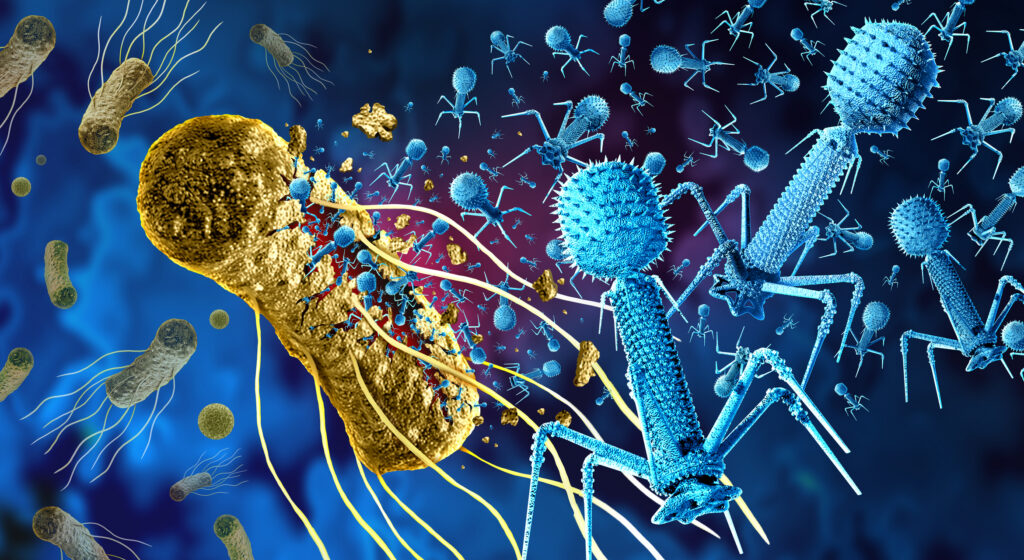
Bacteriophages (phages) can only attack bacteria they can reach. For enteric infections, that requirement creates a problem of timing as well as delivery. An orally administered phage must survive passage through the upper gastrointestinal (GI) tract, reach the relevant intestinal region, and encounter enough susceptible bacteria to amplify. By the time symptoms prompt treatment, the pathogen may already have established a large population or entered tissue and mucosal niches that are less accessible to phages. Administering phages before infection does not necessarily solve the problem, because they can be cleared from the intestine when their bacterial host is absent.
Researchers at Virginia Tech approached this constraint by changing where and when the phage would be produced.1 They engineered nonpathogenic Escherichia coli to carry a prophage that generates obligately lytic progeny targeting Salmonella enterica serovar Typhimurium (STm). The bacterial carrier could colonize the intestine before exposure and replenish the local phage population, creating the possibility of intercepting STm as it entered the lower GI tract. The researchers call the strategy “prophage therapy.”
Engineering a Bacterium to Produce Lytic Phages
The researchers first had to resolve an apparent biological contradiction. The P22 phage genome needed to remain stably integrated as a prophage within the E. coli carrier, but the phages produced by that carrier needed to be obligately lytic when they encountered STm. Otherwise, the progeny could integrate into the target bacterium without killing it and leave the resulting Salmonella lysogen immune to subsequent infection by P22.
The team inactivated the phage c2 gene, which encodes a repressor involved in maintaining lysogeny, and inserted a functional copy into the E. coli chromosome. The carrier could supply the repressor required to maintain the prophage. Its progeny inherited the inactivated c2 gene but not the separate functional copy, leaving them unable to establish lysogeny in STm. The authors call the resulting bacterial construct a “lyto-lysogen” and designate its lytic progeny P22*.
Producing a lytic phage was only part of the challenge. Phages generated within E. coli can carry DNA methylation patterns that leave them vulnerable to restriction–modification (RM) defenses when they enter STm. The researchers expressed a modification gene from an STm RM system in the carrier, altering the phage DNA methylation pattern and improving its ability to evade restriction by the target bacterium.
The carrier therefore maintains the engineered prophage, produces lytic progeny, and influences whether those progeny can infect their target. Both the genetically tractable E. coli K-12 and KP7, a mouse commensal, produced P22*, but KP7 generated lower phage concentrations, a difference that later affected protection in mice.
Establishing the Phage Before Infection
In eight-hour coculture experiments, free P22* or nonengineered E. coli produced only an approximately one-log reduction in STm, and the organisms ultimately coexisted. The P22*-producing lyto-lysogen, in contrast, produced near-complete eradication under the tested conditions. Stronger killing did not eliminate resistance: the rare STm colonies recovered after exposure to the lyto-lysogen were phage resistant.
The main mouse experiments tested whether establishing the system before exposure could improve protection in vivo. Mice received non-lysogenic E. coli K-12 or the engineered K-12 carrier. Four days later, they were challenged orally with either 10² or 10⁶ colony-forming units (CFU) of STm. At both doses, mice colonized with the lyto-lysogen had sustained phage levels, lower relative fecal quantities of STm, and significantly better survival.
A comparison with free-phage prophylaxis isolated the value of continued production. P22* administered four days before STm exposure was completely cleared within one day. STm subsequently established robust fecal populations, and the mice experienced poor survival. The engineered carrier maintained phage during the interval when a discrete dose disappeared.
The KP7 carrier produced less consistent results. It persisted and generated measurable phage but improved survival only after the lower STm challenge. The researchers found no significant difference in fecal STm abundance between the engineered and nonengineered KP7 groups. Phage-resistant STm was also detected after the higher-dose challenge with the K-12 carrier but not after the lower dose. Performance therefore varied with the bacterial chassis and the scale of the pathogen challenge.
The strongest evidence for prevention came from an experiment using a mutant STm strain restricted to intestinal colonization. Engineered E. coli established itself before pathogen exposure, maintained high phage levels, and prevented detectable STm engraftment. The same mice received additional challenges on days 14 and 28, but STm remained unable to establish detectable colonization while the carrier and P22* persisted.
Other treatment sequences were ineffective. Free lytic phage administered after STm colonization did not reduce the pathogen, while free P22* given with nonengineered E. coli before infection did not prevent engraftment. Administering the lyto-lysogen after STm colonization caused only a temporary reduction before pathogen levels recovered. In these models, protection depended on establishing the phage-producing population before STm attempted to colonize.
The Limits of the Mouse Model
The principal experiments relied on streptomycin treatment to support reproducible colonization by both E. coli K-12 and STm. Without the antibiotic, K-12 did not establish stable colonization, while STm burdens and weight loss varied considerably among mice. A human application would need to establish the carrier within an intact microbiome without antibiotic pretreatment, probably using a chassis suited to the human intestinal environment.
The KP7 results show that host compatibility alone will not be sufficient. A carrier must colonize the relevant region and produce enough active phage to maintain protection. The authors also caution that rodent results may not translate directly to humans, noting that less than 3% of gut bacteria are shared between mice and humans.
Pathogen location may impose another boundary. The authors expect the strategy to be most effective against bacteria in the intestinal lumen or mucosa and less effective against pathogens occupying intracellular or tissue reservoirs. The particularly strong prevention of engraftment observed with the noninvasive mutant STm supports a focus on organisms that remain accessible within the intestine).
Host range and resistance further narrow the opportunity. A clinically useful phage would need activity against a sufficient proportion of the targeted pathogen population, and resistant STm appeared both in vitro and after the higher-dose challenge. Prophylactic production may improve the initial conditions for controlling an arriving pathogen, but the study does not demonstrate universal strain coverage or prevention of resistance.
Controlling Two Interdependent Biological Agents
The administered product in this strategy would be the engineered bacterium, but the antimicrobial effect would be mediated by the phage it produces. Development would therefore require control of the carrier’s identity, viability, genetic stability, persistence, and clearance alongside the phage’s identity, yield, host range, and lytic activity.
The U.S. Food and Drug Administration (FDA) defines a live biotherapeutic product (LBP) as a biological product containing live organisms that is intended to prevent, treat, or cure human disease and is not a vaccine.2 A recombinant LBP contains microorganisms purposely modified through the addition, deletion, or alteration of genetic material. The FDA notes that recombinant products are likely to raise additional considerations and encourages developers to seek guidance before submitting an investigational new drug application.
The guidance does not indicate how the FDA would classify this particular combination of an engineered bacterium and a bacteriophage. For recombinant LBPS, however, it identifies relevant chemistry, manufacturing, and control (CMC) expectations, including characterization of strain identity, genetic construction, manufacturing controls, potency, purity, and stability. The FDA also highlights antibiotic susceptibility, transferable resistance, mucosal translocation, and stability of engineered loci as potential concerns.
For a prophage-producing bacterium, identity and potency would extend beyond the number of viable bacterial cells. The carrier would need to retain the intended prophage configuration and continue producing progeny with the expected lytic phenotype. Comparable quantities of bacteria could differ in their capacity to colonize or generate active phage. Because infectivity in this study also depended on the modification state acquired inside the carrier, counting released particles alone might not establish whether they could overcome STm defenses.
Persistence presents a similar tension. The carrier must remain long enough to maintain protective phage levels, but its post-dose clearance and shedding would also need to be understood. The FDA states that an environmental assessment is likely to be needed for organisms whose eradication is difficult to document or whose ecological fitness exceeds that of their wild-type counterparts.
Human trials of other engineered oral E. coli strains show that these kinetics can be measured. One engineered E. coli Nissle strain was cleared within four days of the final dose,3 while another remained viable and metabolically active in feces during dosing but was undetectable two weeks after treatment ended.4 These results do not predict the behavior of a prophage-producing strain, but they illustrate the need to measure viable shedding, functional activity, and clearance separately.
The in situ approach moves the final stage of phage production into the patient’s intestine, making reproducible biological performance within that variable environment part of the product’s mechanism and control strategy.
When Would Prophylactic Exposure Be Justified
The new study demonstrates a means of producing preventive phage exposure but does not identify who should receive it. A clinical indication would require a sufficiently predictable risk of encountering the target pathogen and a benefit capable of justifying administration of an engineered organism before disease exists.
The anticipated exposure window, required duration of protection, phage host range, and location of the target pathogen would all shape that decision. Longer persistence could extend protection while increasing the importance of genetic stability, shedding, ecological behavior, and reliable clearance. A narrowly targeted phage would provide no protection against strains outside its host range.
The study most directly supports further investigation of pathogens that attempt to establish themselves in the intestinal lumen or mucosa, where the carrier can produce phage in the same environment. It provides much less support for infections sustained by intracellular or tissue-resident bacteria or for infections that have spread beyond the intestine.
Producing the Defense Before It Is Needed
The study does not establish a human prophylactic, and its antibiotic-treated mouse models, variable chassis performance, host-range requirements, and resistant STm leave substantial translational questions. It does show that the timing problem in enteric phage therapy can be approached through biological engineering.
Instead of asking an administered phage to persist until its host appears, prophage therapy establishes a bacterial source that produces the phage in advance. In these models, that sequence allowed the antimicrobial to confront STm during its attempt to colonize, when free phage given earlier or phage-based interventions given later were ineffective.