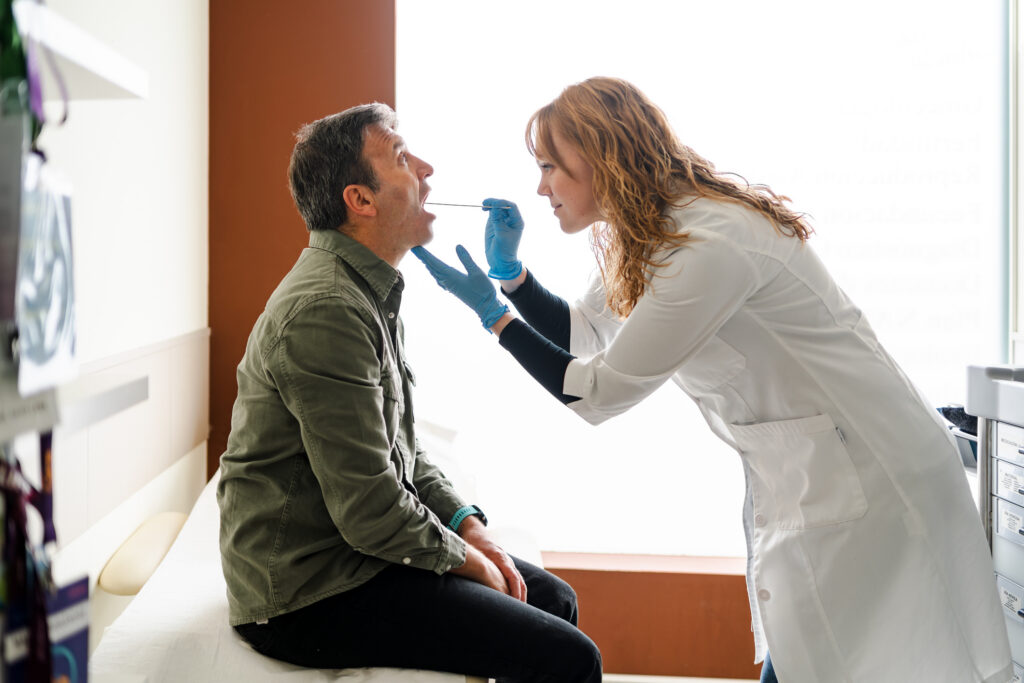
At 48 commune health centers in Vietnam, researchers tested whether a rapid blood test could help clinicians decide when to prescribe antibiotics for non-severe respiratory infections.1 Prescribing at the first visit was lower at centers that introduced the test, but it remained common in both groups. Clinicians prescribed antibiotics to 93.1% of patients in the intervention group and 98.2% under routine care. Only 14% of patients in the intervention group received the test. The researchers noted that many patients received care remotely, partly because of the COVID-19 pandemic, and could not be tested.
Clinicians also frequently prescribed antibiotics after a low test result. The test measured C-reactive protein (CRP), a marker of inflammation. The trial protocol advised withholding antibiotics when CRP was below 10 milligrams per liter and the patient had no clinical signs of severe illness. The final decision rested with the treating clinician. Among all tested patients below that threshold, 51% received an antibiotic prescription at the first visit.
There was good reason to try the approach in routine care. In an earlier Vietnamese trial reported by the same group, 64% of patients assigned to CRP testing used antibiotics within 14 days, compared with 78% under routine care.2 That earlier study tracked use over two weeks, while the later trial measured prescribing at the first visit. The later trial brought two implementation questions into view. How many patients can a testing service reach, and how do clinicians use the result when they have one?
When Testing Changes Antibiotic Use
In rural Uganda, a community health worker who runs a CRP test can also act on it. Workers evaluating children with fever and cough used a clinical algorithm that incorporated the test into their assessment.3 They gave or prescribed antibiotics at the first visit to 70.8% of children during intervention periods, compared with 91.8% during control periods. Clinical failures were uncommon in both groups, leaving uncertainty about the size and direction of any effect on that outcome.
A separate trial at three Ugandan outpatient sites found no overall prescribing difference after introducing a different package of point-of-care tests, a clinical algorithm, and training and communication.4 In Burkina Faso, a trial of a diagnostic and training package for patients with non-severe acute febrile illness found that clinicians prescribed antibiotics at enrollment to 33.2% of patients in the intervention group and 58.1% under standard care.5 All patients who completed day-seven follow-up had recovered in both groups.
Each trial measured the effect of a care pathway as delivered. The community study in Uganda shows that workers using a CRP-guided algorithm can reduce prescribing among children with fever and cough. The outpatient trials show that broader diagnostic packages can produce different results. Differences in patient populations, tests, and treatment protocols leave open which components accounted for the variation.
What Makes a Result Usable During a Visit
CRP offers an indirect signal about the cause of illness. In a study of stored serum from febrile patients in Southeast Asia, a threshold of 10 milligrams per liter flagged 95% of samples from patients with bacterial infections and correctly classified 49% of samples from patients with viral infections as below the threshold.6 At 20 milligrams per liter, the corresponding figures were 86% and 67%. In practical terms, raising the threshold meant missing more bacterial infections while flagging fewer viral infections as bacterial. Malaria complicated interpretation further. CRP concentrations were higher in patients with malaria than those with viral infections, and the researchers found no statistically significant difference between concentrations in bacterial infections and malaria.
Those findings describe how the biomarker performed in the samples studied. A clinic choosing a fingerstick test faces a separate question about how accurately the device measures CRP. In a laboratory evaluation of 17 commercial point-of-care tests, most of the eight quantitative tests showed substantial differences from the reference method that varied with CRP concentration.7 Agreement also varied among the nine semiquantitative tests. If a treatment protocol changes course at a particular threshold, the device’s performance around that threshold is especially important. A reading in the wrong range can send a clinician down a different branch of the algorithm.
The rural Uganda trial also shows what staff needed to learn before they could use the result. Local laboratory personnel and study staff taught community health workers how to run and interpret the Actim CRP lateral-flow test. Workers received illustrated instructions and refresher training. In a follow-up study, several workers linked changes in their prescribing practice to the algorithm, their participation in the trial, or the training.8 Some described initial caregiver mistrust. Two recalled caregivers gaining confidence after seeing a child recover without antibiotics. Those accounts show why training has to prepare workers for the conversation that follows the result as well as the test procedure itself.
Who performs the test and when can also determine whether it fits into a visit. Research nurses ran the point-of-care tests in the Burkina Faso trial. A broader review of rapid testing for fever in sub-Saharan Africa found examples of higher use when triage nurses tested patients early enough for clinicians to have the result at the consultation.9 Testing was harder to integrate when it added a long wait or sent patients elsewhere. A turnaround time on a product specification tells a clinic how long the assay takes. The clinic still has to work out when to collect the sample, who can run the test, and how to get the result to the person making the treatment decision.
Keeping Tests in Stock Where Laboratories Are Scarce
In Ghana’s Bono Region, researchers surveyed 102 randomly selected community health facilities, 12 district depots, and a regional depot.10 Across the community facilities, they found 10 of the 18 point-of-care test types they assessed. A follow-up qualitative study traced some of the difficulties behind that snapshot.11 Providers and depot staff described requisitions reaching depots that had already run out, deliveries of kits close to expiry, and test purchases competing with expenses such as casual staff and renovations.
Each problem has a different point of intervention. A facility that lacks money to reorder needs access to purchasing funds when stock runs low. A depot that cannot fill orders needs reliable information on what facilities are using and when they are likely to run out. A clinic receiving kits close to expiry needs time to use them at its actual testing volume. Ghanaian providers and depot staff proposed more reliable financing and better delivery arrangements. The World Health Organization’s procurement guidance identifies terms buyers can put into contracts, including minimum remaining shelf life at delivery, staggered shipments where appropriate, and clear responsibilities for transport and storage.12
The equipment a test requires also changes what a purchaser has to provide. The earlier Vietnam trial used fingerstick blood with a quantitative analyzer, and the manufacturer supplied the equipment and reagents. The rural Uganda study used a semiquantitative lateral-flow test. For a reader-based system, a purchase plan can include installation, maintenance, and servicing alongside a continuing supply of consumables. Specimen collection materials, appropriate storage, and disposal have to be accounted for across formats. The practical choice is which setup a facility can keep running after the initial delivery and training.
What It Costs to Get a Patient Tested
The rural Uganda trial team paid about U.S. $1.70 per CRP test when buying directly from the manufacturer. The researchers reported that a course of amoxicillin for a child aged one to five cost about $0.50–1.30 at a local drug shop.3 That comparison helps explain the financing challenge. The test can cost more to buy than the medicine it might avert, even before a program accounts for the resources required to deliver testing. The case for funding therefore depends on what the service changes for patients and how the program values those changes.
A cost–benefit analysis drawing on the earlier Vietnam trial illustrates how much depends on clinicians acting on the result. At an assumed test price of $1, the researchers estimated an incremental cost of $0.93 per patient and a modeled societal benefit of $0.82 per patient.13 Under the prescribing behavior observed in the trial, the intervention was not cost-beneficial in the analysis. At higher levels of adherence to the test results, the modeled conclusion changed. The program incurs the testing cost regardless of whether the result changes the prescription.
A separate analysis for Burkina Faso, Ghana, and Uganda estimated costs per consultation, accounting for staff time, tests, analyzers, and training.14 The model projected that malaria testing followed by CRP testing for malaria-negative patients could lower prescribing at a small additional cost in Burkina Faso and Uganda and at lower cost in Ghana, compared with each country’s standard care. The base case assumed patients who tested positive for malaria would receive no antibiotics, although the trial data showed that some did. A program that changes which tests clinicians order can still face a separate challenge in changing what they prescribe afterward.
Zambia’s antenatal syphilis program provides a comparison for what happens to the cost per completed screen during rollout.15 Researchers estimated an incremental provider cost of $3.19 per woman screened at pilot sites and $11.16 at preliminary rollout sites. Screening coverage at the first antenatal visit was 97.3% at the pilot sites and 34.8% at the rollout sites. The researchers attributed the higher cost per screen primarily to lower testing volume, with higher kit prices also contributing. Several rollout sites reported repeated stockouts, while one site screened relatively few patients despite reporting no stockouts. The program spent less on some activities during rollout, including quality assurance, yet each completed screen cost more. A purchasing budget based on expected volume can look very different once the denominator is the number of patients actually tested.
What Developers Are Building
Lumos Diagnostics’ FebriDx builds on the host-response approach used in the CRP trials.16,17 The fingerstick test detects CRP alongside myxovirus resistance protein A, a second host-response marker, to help evaluate patients with acute respiratory symptoms. Staff read the result visually after 10 minutes, so the test requires no reader. Unopened tests should be stored at 4–25 °C, a range clinics need to account for when planning transport and storage.
Other developers are designing tests to identify specific infections. Chembio says its proposed point-of-care test for acute typhoid fever will accept fingerstick whole blood, serum, or plasma and is expected to deliver results within minutes using a portable reader.18 CARB-X’s development award includes planned performance assessment using sample sets in Africa.19 Scout is developing a rapid molecular test for gonorrhea and chlamydia for use at the point of care or at home. CARB-X backed the project as a low-cost diagnostic, and Scout says the subsequent award will advance it into verification and validation.20,21
For urinary tract infections, a test can also help determine which antibiotic to use. Sysmex says its PA-100 system can test bacterial susceptibility directly from fresh urine in 30–45 minutes, depending on the species.22 A randomized primary care trial of a different technology, the Flexicult point-of-care urine culture kit, measured what happened to prescribing.23 Fewer patients in the Flexicult group received an antibiotic prescription at the initial consultation, but by day three there was no statistically significant improvement in how often antibiotic use matched laboratory culture results. That gives developers a concrete outcome to measure alongside turnaround time: how often patients receive treatment consistent with the susceptibility findings.
What a Rollout Should Demonstrate
A rollout evaluation starts with everyone eligible for testing. How many received a result before the treatment decision, and what kept others from getting one? Those measures show where delivery needs work. To assess what testing changed, compare antibiotic use and patient recovery with outcomes before rollout or in a comparable group receiving usual care. Track the cost per completed test to judge what it would take to sustain the service.
Where laboratory access is limited, a rapid result can inform a decision that clinicians would otherwise make with less information. The goal is to avoid antibiotics when patients can recover without them and preserve timely treatment when they need it. A rollout should show how often it delivers that benefit under the conditions clinics face every day.