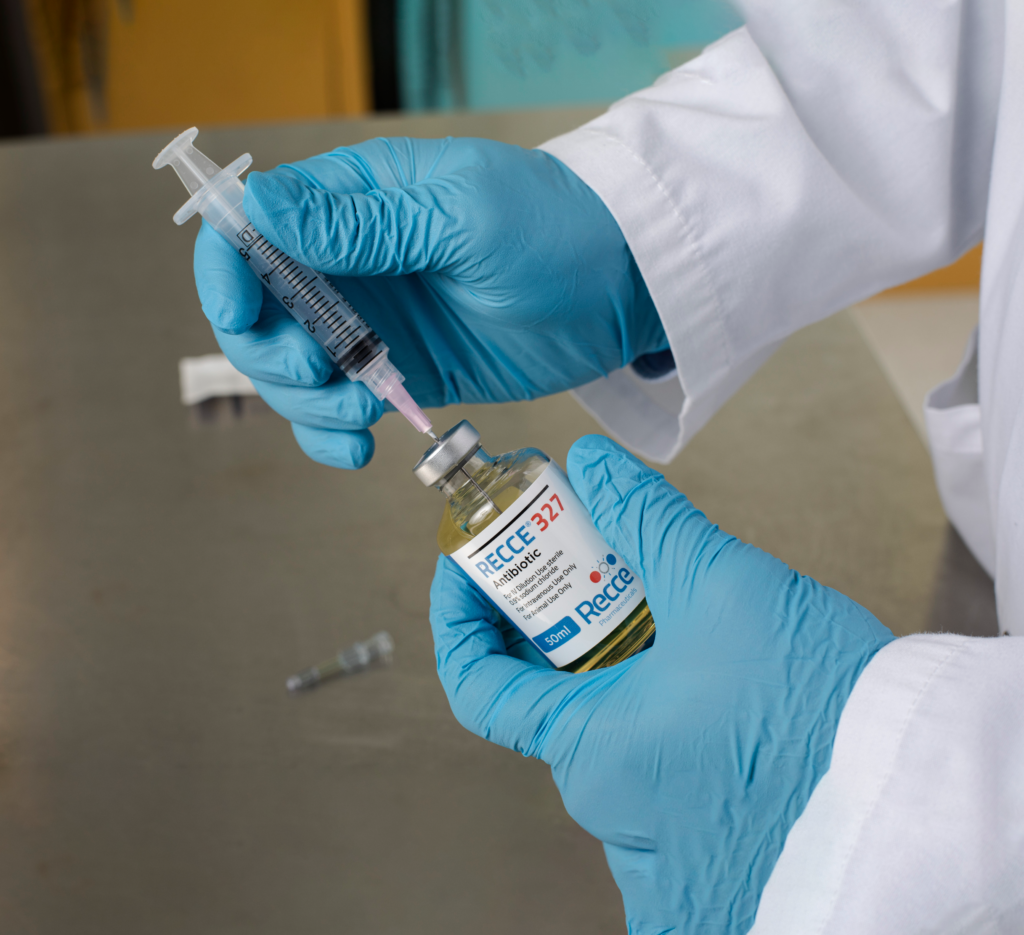
Recce Pharmaceuticals is advancing a synthetic polymer anti-infective through two phase III diabetic foot infection studies while building a commercial strategy around proprietary production and regional licensing. In a conversation with disAMR, CEO James Graham explains the decisions behind that approach, including his preference for funding that preserves ownership and markets that can support product sales.
An Antibacterial Business Built Around a Paying Market
“If there is not a market, we don’t go there,” says James Graham, Chief Executive Officer and Managing Director of Recce Pharmaceuticals.
Urgent need for new antibacterial treatments does not necessarily create a market that can sustain their development and supply. Recce has chosen an initial indication and markets where Graham believes clinical need can support a viable business, while retaining control of its technology and manufacturing.
The Australian company is developing RECCE® 327 (R327), a synthetic polymer antibacterial whose topical gel formulation, RECCE® 327G (R327G), is in two registrational phase III studies for diabetic foot infections (DFIs). An Indonesian study offers a potential route to its first registration. An Australian program supports wider regulatory ambitions, alongside a proposed license in the Middle East and North Africa.

In a conversation with disAMR, Graham explained how that market focus connects Recce’s founding chemistry with its choices about clinical development, production, financing, and regional partnerships.
A Polymer Designed with Particular Properties in Mind
Recce’s founding idea came from Dr. Graham Melrose, whose career included senior research responsibilities at Johnson & Johnson. According to Graham, Melrose had encountered acrolein, a substance with known antimicrobial properties but toxicity and handling hazards that limited its therapeutic appeal. Melrose sought to preserve antibacterial activity while overcoming acrolein’s limitations and defining how the product would interact with bacteria and could be manufactured.
“As a polymeric chemist, it is normal to try to create a compound of defined properties, and he very much did that,” Graham says.
Recce describes R327 as a fully synthetic anti-infective with broad-spectrum activity against Gram-positive and Gram-negative bacteria. Its proposed mechanism involves interactions with bacterial proteins and interference with essential cellular functions, including metabolism and ATP production. Graham argues that those effects provide a basis for antibacterial activity that differs from dependence on a single susceptible target site.
Since antimicrobial resistance (AMR) is a ubiquitous challenge to the efficacy of antimicrobials, resistance testing is central to the company’s proposition. Graham describes repeated-exposure studies in which researchers propagate surviving bacteria and expose them again, examining whether activity declines as the population adapts. Recce reports that it has observed no development of resistance in the studies conducted to date.
For Graham, the desired property is “the ability to work and keep on working with repeated use.” He attributes that finding to rapid interference with bacterial energy production and additional interactions that, he believes, make adaptation more difficult. Whether that durability extends to clinical practice will require continued investigation.
Why Diabetic Foot Infections Came First
Recce’s development ambitions include systemic treatment for serious infections such as sepsis, but the company has prioritized DFIs as its lead registrational opportunity.
That choice reflects the company’s assessment of where R327’s properties could address a substantial clinical need and support a commercially viable product. Infected diabetic foot ulcers can contain multiple bacterial species. Recce believes broad antibacterial coverage could be useful in that setting, with a topical formulation delivering treatment directly to the affected area.
Local delivery is particularly relevant to Recce’s reasoning. Graham points to the difficulties that vascular impairment can create in patients with diabetic foot ulcers and sees direct application as an opportunity to achieve useful exposure at the infection site. R327G allows the company to pursue that approach while limiting systemic exposure.
“We focus on the infection,” he says.
Recce’s product targets infection rather than tissue regeneration. Controlling infection could support wider wound management, but the clinical program examines whether R327G resolves or improves the infection itself.
Graham sees significant unmet medical needs, serious consequences from treatment failure, and costs beyond the price of an antibiotic. He believes a new product could compete on the value of its outcomes.
Recce reports that all patients in its completed phase II acute bacterial skin and skin structure infection study met a combined endpoint of complete cure or significant improvement. The phase III programs examine larger populations and different controls.
In Indonesia, the company is conducting a double-blind, placebo-controlled study of R327G in patients with mild diabetic foot infections, with planned enrollment of up to 310 participants. The Australian study compares R327G with physician-selected standard-of-care antibiotics in patients with mild or moderate infections. It will test whether R327G meets a prespecified threshold for non-inferiority to established treatment and will also examine whether it performs better. Calibrated digital photography supports wound assessment.
The studies will provide evidence about infection response within the wider context of wound care and other interventions. A successful topical program could also generate revenue and partnerships for subsequent applications.
Manufacturing as Part of the Commercial Model
Recce’s decision to retain core manufacturing capability follows directly from its view of the product. The proprietary synthesis process is a source of control over supply, production economics, and the technology offered to prospective partners.
“The method of synthesis to manufacture is entirely proprietary to ourselves,” Graham says. “And we’ve been very strategic in keeping that.”
Graham describes commercially available equipment adapted to Recce’s requirements and a defined manufacturing fingerprint. The company uses its own personnel and equipment for much of the work. He believes favorable capital requirements and operating economics make internal production ideal at its current stage.
Graham says producing clinical material and preparing for initial commercial supply without a large manufacturing investment has allowed Recce to direct more capital toward development. Retaining process knowledge also preserves an important role in licensing relationships, where partners would need dependable access to the product.
The operating arrangement combines internal control with selected external capabilities. Graham says external parties contribute to gel formulation, and the company relies on other organizations’ manufacturing licenses in some circumstances while using its own people and equipment.
“It is made in Australia. It is led by our team. And it is majority manufactured using our people and capability,” he says.
Graham expects greater investment in internal infrastructure when commercial orders justify it. Until then, using existing licensed capabilities helps preserve resources while Recce protects its core synthesis process.
Financing Without Giving Up Future Options
Graham evaluates funding by both its immediate contribution and the conditions that could affect Recce’s future.
He is skeptical of some grant arrangements in the antimicrobial sector because he believes conditions governing intellectual property (IP) or commercialization can reduce a developer’s control and deter later investors, even when the funding helps advance early research. That assessment has shaped Recce’s preference for support that preserves ownership and commercial flexibility.
The company has relied heavily on investor capital and Australia’s research and development tax incentive. Recce describes a refundable benefit of 43.5% on eligible expenditure, returning part of its development spending in cash without requiring repayment or an ownership interest in the IP.
“We keep the cash. We keep the IP. It’s wonderful,” Graham says.
Those refunds extend development resources. Recce’s Advanced Overseas Finding also makes approved research outside Australia eligible for the incentive. The arrangement covers up to A$85 million of qualifying expenditure, rather than an equivalent cash award.
U.S. military collaborations support additional applications. Recce has two Cooperative Research and Development Agreements with U.S. Army research organizations, together with support for burn-wound research. Those relationships contribute capabilities and resources to applications that sit alongside the lead DFI program.
Recce benefits substantially from government-backed development support, but its commercial plan depends on sales and licensing rather than future antimicrobial-specific purchasing incentives. Management still needs to identify users, payers, and revenues that could sustain the business.
Executing that plan also requires experience beyond the founding science. Graham points to members of the medical and leadership team with experience developing and commercializing drugs, including diabetic ulcer therapy, alongside operational and manufacturing expertise. He highlights Dr. Alan Dunton’s experience with Regranex, a product focused on diabetic ulcer regeneration, as relevant background for understanding the treatment setting even though Recce’s objective is infection control.
Indonesia and the Search for a Regional Route to Market
Indonesia became central to Recce’s plans through discussions with local stakeholders, Graham says.
“I didn’t necessarily wake up one day and go: Indonesia is it. But when Indonesia came to us and we learned about the opportunities that existed, it became very obvious that Indonesia was a wonderful choice.”
He describes interest from government and regulatory stakeholders who saw the platform as relevant to the country’s infection burden and large diabetes population. Those conversations brought together the clinical opportunity, a development pathway, and the prospect of an initial commercial market.
For Recce, the Indonesian study provides access to a relevant patient population and relationships that could support a registration application. The program has an expedited regulatory review pathway, and the company reports that a study site completed an inspection without findings that would prevent the trial from continuing.
Recce hopes to use the Indonesian evidence in other markets while meeting each territory’s requirements. The Australian trial is intended to support domestic registration and further U.S. development while generating evidence for other applications.
The proposed Middle East and North Africa license illustrates how Recce plans to extend its commercial reach. The company has disclosed a non-binding term sheet with a regional pharmaceutical company for an exclusive license, including proposed upfront and milestone payments and a share of net sales. A definitive agreement remains a future milestone.
A regional partner would combine Recce’s product and supply capabilities with local commercial infrastructure, extending its reach without requiring it to build that infrastructure itself.
“We are fundamentally driven by the economies that are available in markets,” he says.
Graham supports the prospect of broader improvements to antimicrobial economics, but he is unwilling to make them a prerequisite for Recce’s progress.
“You don’t bet your future on hoping the government does something good for you,” he says.
What a Lead Product Could Make Possible
The topical DFI program is the immediate priority, but R327 remains the basis of a wider development agenda. Recce has completed early intravenous studies examining safety, tolerability, and exposure. Graham reports intravenous dose escalation up to 6,000 milligrams delivered by a one-hour infusion, which he describes as safe and well tolerated. Establishing efficacy in infected patients is the next clinical task.
Systemic treatment remains an ambition for serious infections, including complicated urinary tract infections and sepsis. Recce also reports preclinical work in respiratory infection models and is considering clinical testing of inhaled delivery. Each formulation and route requires its own development work.
Burn-wound infections provide a further topical application. Graham describes earlier Australian clinical experience alongside ongoing U.S. military preclinical research collaborations. Those programs investigate the product in a setting with different practical requirements from DFIs.
For now, the concentration of resources on R327G reflects the decision to pursue its nearest opportunity for registration and commercial sales.
At the time of the interview, Graham anticipated Indonesian clinical data and progress in licensing discussions within the following two months. The interim analysis depends on patient completion, and the company will disclose results through the Australian Securities Exchange. Graham expects the Australian study to conclude by the end of 2027.
For other antimicrobial developers, Graham’s advice begins with identifying an unmet need that the technology can credibly address and preparing for the difficulty of delivering a treatment.
“An unmet need is normally unmet because it’s bloody hard,” he says.
Recce has organized its development around an infection it believes R327G can treat and markets it believes can sustain the product. The next challenge is to turn the lead trials and prospective partnerships into an approved treatment that the company can reliably supply and patients can access.



